
THE FEED BASKET
for macrozoobenthos
THE NURSERY FOR JUVENILE FISH AND SOLUTION FOR CLOGGED RIVERS.
About Stefan Baur
Inventor and Visionary
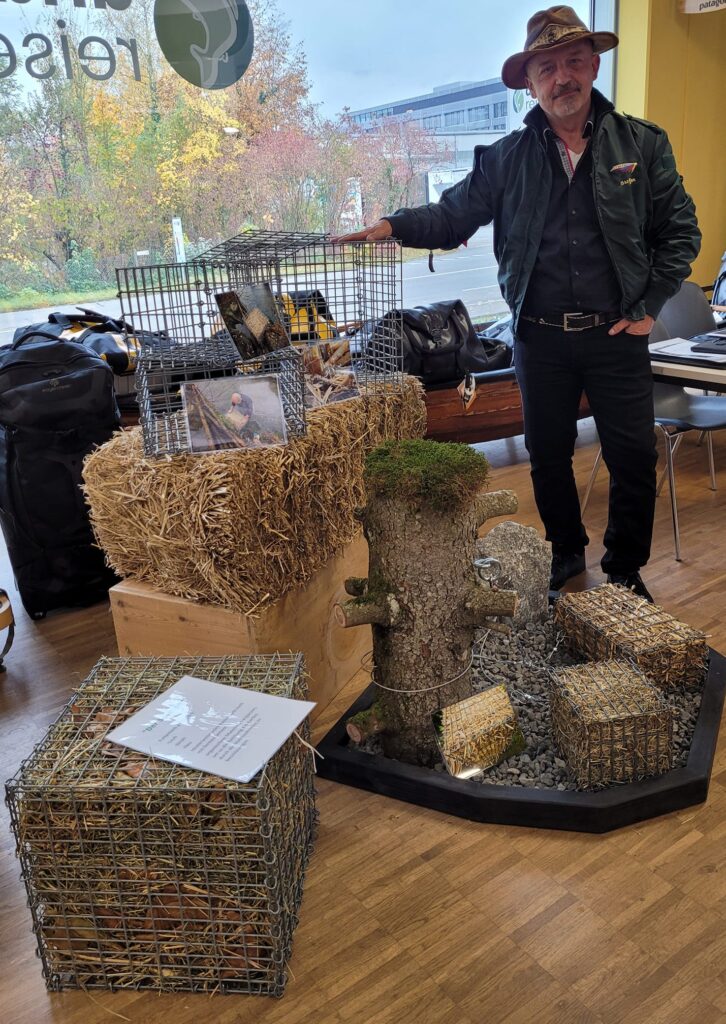
Stefan Baur is not only a passionate fly fisherman, but also a committed environmentalist and innovator in the field of water revitalisation. His passion for nature and his desire to preserve ecological diversity in waterways have inspired him to find unique solutions for developing a healthy habitat for small organisms at kolmation.
As an experienced fly fisherman, Stefan understands the importance of intact aquatic ecosystems for the survival of fish and other aquatic life. His many years of experience in fly fishing have helped him develop a deep understanding of the functioning of flowing waters and recognize the challenges they face.
Stefan Baur is not only actively involved in water conservation but also enjoys sharing his knowledge and experiences with others. He supports local communities, biologists, and fishing clubs in implementing water revitalization projects and is available as a consultant.
In his free time, Stefan is often found on the banks of rivers and streams, where he not only pursues his hobby but also enjoys the beauty and value of nature. His commitment to environmental protection and his innovative spirit make him a role model for all who are dedicated to the preservation of our natural habitats.
Frequently Asked Questions
What is macrozoobenthos?
Macrozoobenthos refers to all invertebrates on the riverbed that are approximately 1 mm or larger in size.
What are gravel spawners?
Danube salmons, trout, char, grayling, barbel, nase, chub, etc. They all need gravel banks in flowing waters to spawn.
What causes silting in watercourses?
The solidification of the water bed leads to a loss of habitat and food for aquatic organisms such as gammarus and other small invertebrates.
What are the effects of clogging?
The consolidation of the riverbed leads to a loss of habitat and food for aquatic organisms such as crayfish and other small invertebrates. In addition, gravel spawners are unable to dig spawning pits due to the consolidation of the riverbed.
What are feed baskets?
Feed baskets are steel baskets or stainless steel baskets, manufactured individually according to requirements.
Why feed baskets?
Feed baskets are mainly used where stream beds are hardened by sediments (silt/clay, colmatage).
Where are feed baskets used?
Feed baskets can be used in any flowing water where gravel spawners are native. It does not matter whether the stream bed is silted up or whether there is mostly loose sediment (gravel).
Does a feeding basket need to be placed in a specific location in the stream/river?
The location of a feed basket is extremely important! The location, the top layer of the stream bed, must consist of loose or silted gravel. The organic content of a feed basket must also be constantly supplied with oxygen. However, the most important aspect is the water depth. The feed basket must always be under water, even in the hot summer months. Semi-shaded and shaded positions are also very important. That is why I always recommend a personal consultation with me on site at the respective watercourse.
How big should a feeding basket be?
The size and shape are determined by the size and width of the body of water and, above all, the depth of the water. The flow velocity is also a decisive factor! There are 250 shapes and sizes of feed baskets.
What types of feed baskets are available?
There is the classic shape, the so-called hexahedron (cube). Or the polyhedron (rectangular prism) and the so-called suitcase systems with the lowest possible height and the largest possible base area.
What types of feed baskets are available?
The classic type is the steel basket; it is also available in V2 stainless steel on request. This can be manufactured for all gravel spawners in Europe. The danube salmon baskets are special and, unlike the other baskets, have significantly larger openings between the steel bars and greater material thickness. The final variant is the FK for rearing in flowing waters. These are small V2 stainless steel baskets.
What organic materials are used?
Organic straw – However, finer substances such as organic hay can also be added. In autumn and the following months, fallen leaves are also an ideal supplement.
How should a feeding basket be filled?
It is not quantity but density that is crucial for success! Personal consultation is also recommended here.
When does a feeding basket need to be refilled?
You should check the feeding basket for the first time after about three weeks, or at the latest after the microorganisms have eaten all of its contents. However, it is advisable to refill the feeding basket when there is still a residual amount of detritus in the basket. This residual amount must be mixed in with the new organic material. The effect is that the feeding basket is already repopulated with microorganisms during the refilling phase, thus accelerating the entire process of full colonization.
How is a feeding basket mounted and secured?
The feed baskets can be attached in various ways:
- using impact anchors on boulders and embankment stones
- on dead wood
- protruding burl
- on fascines
- by stabilizing piles
- V2 ropes or chains are used as the connection between the anchor and the basket.
A personal consultation is recommended!
How much does a feeding basket cost?
Since I produce over 250 different feed baskets in various sizes, shapes, and materials, it is impossible to list the price of each individual basket, especially since the prices for steel/stainless steel are constantly changing.
Here are a few guidelines:
- Steel feed basket for young fish from CHF 120/each.
- Steel feeding basket for young danobe salmon from CHF 200/each.
- Feeding basket V2 for rearing streams from CHF 120/each.
- Feeding basket V2 for young fish from CHF 300/each.
Is there a warranty on feeding baskets?
The material of my feed baskets is extremely tough and robust!
Steel baskets that have been in use for several years are in almost mint condition. I am therefore able to offer a 10-year warranty on the materials and workmanship of the baskets. This is conditional on the baskets being used properly.
Of course, I cannot guarantee against environmental influences such as landslides, flooding with massive amounts of driftwood (logs), etc., and the resulting damage to the feed baskets. There is not a single known case in Europe where natural events have damaged or destroyed one of my baskets! The warranty period for V2 stainless steel baskets is significantly longer in terms of corrosion.
 English
  German